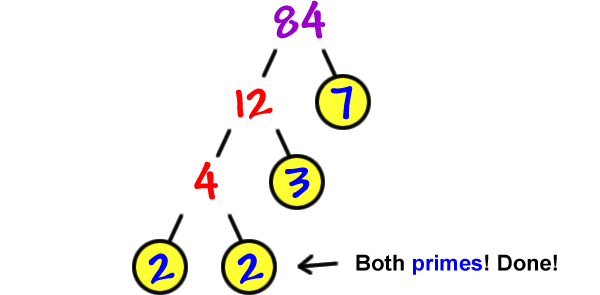
Factor Tree For 135. Thus, the factors of 135 are the numbers that divide 135 completely and leave a remainder 0. On splitting 33 further and writing it as multiples of numbers it would be 11 x 3.
Prime Factorizations 3 from www.coolmath.com
What is a factor tree. Factor tree another way to do prime factorization is to use a factor tree. Let us learn here how to find factors of 15 along.
Look At The 2 Factors And Determine If At Least One Of Them Is Not Prime;
So, draw the factor tree of 135 and express all its prime multiplies. Repeat until resulting quotient is a prime number. Positive integers that divides 1350 without a remainder are listed below.
135 = 3 X 45 45 = 3 X 15 15 = 3 X 5 If We Write Into Multiples It Would Be 135 X 3
1, 3, 5, and 15 are the factors of 15. As 135 is a composite number, it has many factors other than 1 and 135. Divide the given composite number by its smallest prime factor.
Factors Of 15 Are The Numbers That Divide The Original Completely.
The biggest factor of 135 is 135. Factor tree is the easiest way to find the factors of a given number. 1 × 135 = 135 3 × 45 = 135 5 × 27 = 135 9 × 15 = 135
On Splitting 66 Further And Writing It As Multiples Of Numbers It Would Be 33 X 2.
Here you can find the answer to questions related to: So it is divisible by 2. On splitting 33 further and writing it as multiples of numbers it would be 11 x 3.
Factor Tree Another Way To Do Prime Factorization Is To Use A Factor Tree.
Prime factorization of 135 in exponential form: Creating a factor tree involves breaking up the composite number into factors of the composite number, until all of the numbers are prime. It displays the factors in a fraction of seconds.