Contrast Covalent And Ionic Bonds. The ionic bond is the electrostatic force of attraction between two oppositely charged ions. Compare and contrast ionic and covalent bonds || ionic bonding occurs between atoms that have opposite needs for electrons (metals and nonmetals) and results in a transfer of electrons.
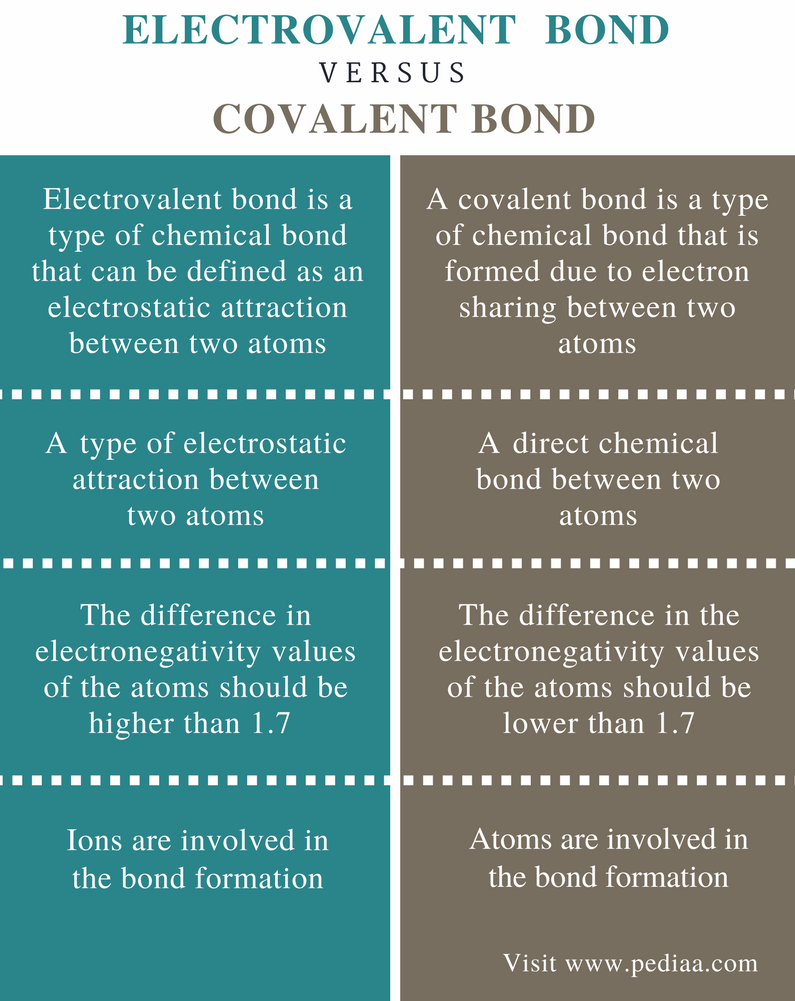
Difference Between Electrovalent and Covalent Bond from pediaa.com
Ionic and covalent bonds are fundamentally different in the way they are formed. In contrast to covalent bonds, an ionic bond involves an unequal sharing of electrons is a force of attraction between different molecules results in a partial positive or negative charge on a molecule occurs when electrons are gained or lost. Bond in which one or more pairs of electrons are shared by two atoms.
1) In Both Bonds, Electrons Are Involved To Form Ionic & Covalent Bond.
Similarities between ionic and covalent bonds. Metallic bonds are the chemical bonds that join metals to metals. The two extreme cases of chemical bonds are:
Covalent Bond Exists As Solids, Liquids And Gasses, Metallic Bonds And Ionic Bonds Exist In The Solid State Only.
One shares, and the other trades. Ionic and covalent bonds attract the atoms of different substances together to form the molecules of compounds, while hydrogen bonds are forces that tend to attract molecules to each other. Polar colavent = bonding electrons shared unequally.
However, By Doing This, Both Bonds Create Elements That Are Neutrally Charged Making Them Stable Compounds.
Compare and contrast covalent ionic and hydrogen bonds. There are four major types of chemical bonds: A covalent bond is formed between two non metals which makes the attraction between the atoms less “strong”.
2) Both Bonded Molecules Have Some Forces Of Attraction.
Collected from the entire web and summarized to include only the most important parts of. A covalent bond is a type of chemical bond that involves sharing of shared pairs or bonding pairs (electron pairs) between atoms. Covalent bonds, ionic bonds, hydrogen bonds,.
Ionic Bonds Are Comparatively Hard, While The Covalent Bond Is Not Hard Except Few, Such As Diamonds.
Covalent bonding occurs between atoms that have similar needs for electrons (two nonmetals) and results in a sharing of. Comparison table of ionic vs covalent now let’s draft the comparison between ionic and covalent in a table below conclusion 5) in both bonds valence electrons take part in bonding.