Calculate The Change In Gibbs Free Energy For Each Of The Following Sets Of Δhrxn Δsrxn And T. Calculate the change in gibbs free energy for each of the following sets of δhrxn ∘, δs∘rxn, and t. The 1st 1 we have 100 drifting well, a jewel minus 2 90 eat caldron.
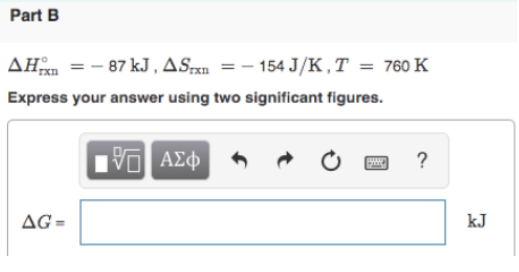
This problem has been solved! Calculate the change in gibbs free energy for each of the following sets of δh∘rxn, δs∘rxn, and t. It is defined by the gibbs equation:
As You Know, The Change In Gibbs Free Energy For A Given Chemical Reaction Tells You Whether Or Not That Reaction Is Spontaneous At A Given Temperature Or Not.
Calculate the change in gibbs free energy for each of the following sets of δh∘rxn, δs∘rxn, and t. And since we have all those values given to us, we can just plug in and see what we get. Free energy and free energy change—the gibbs free energy, g, is used to describe the spontaneity of a process.
Okay, You Draw, Subtract By A Sometimes Now You Can Get It.
Calculate the change in gibbs free energy for each of the following sets of δh ∘ rxn , δs ∘ rxn , and t. (assume that all reactants and products are in their standard states.) part a δhrxn∘=−92kj, δs∘rxn=−141j/k, t=310k express your answer as an integer. The term free energy of a process such as a rate or equilibrium and the free energy of standard process often an equilibrium, which could be the process under investigation or some other.
Free Expert Solution Using The Equation:
Gibbs free energy is a state function hence it doesn’t depend on the path. And so the basic function we gon use is the relationship between jeeps for energy and a p and entropy. Don't h modesty don't s.
So We Must Convert This Into Killer Jewell.
So change in gibbs free energy is equal to the change in enthalpy minus the product of temperature and entropy change of the system. Recall that δg˚rxn and k are related to each other: Use this relationship which arises from the 2nd law of thermodynamics:
It Is Defined By The Gibbs Equation:
Answer to solved calculate the change in gibbs free energy for each of Calculate the change in gibbs free energy for each of the following sets of δh∘rxn, δs∘rxn, and t, assuming that all reactants and products are in their standard states. Calculate the change in gibbs free energy for each of the following sets of δhrxn, δsrxn, and t.part bδh°rxn= 88 kj , δsrxn= 152 j/k , t= 760 kexpress your answer using two significant figures.part fpredict whether or not the reaction in part b will be spontaneous at the temperature indicated.
