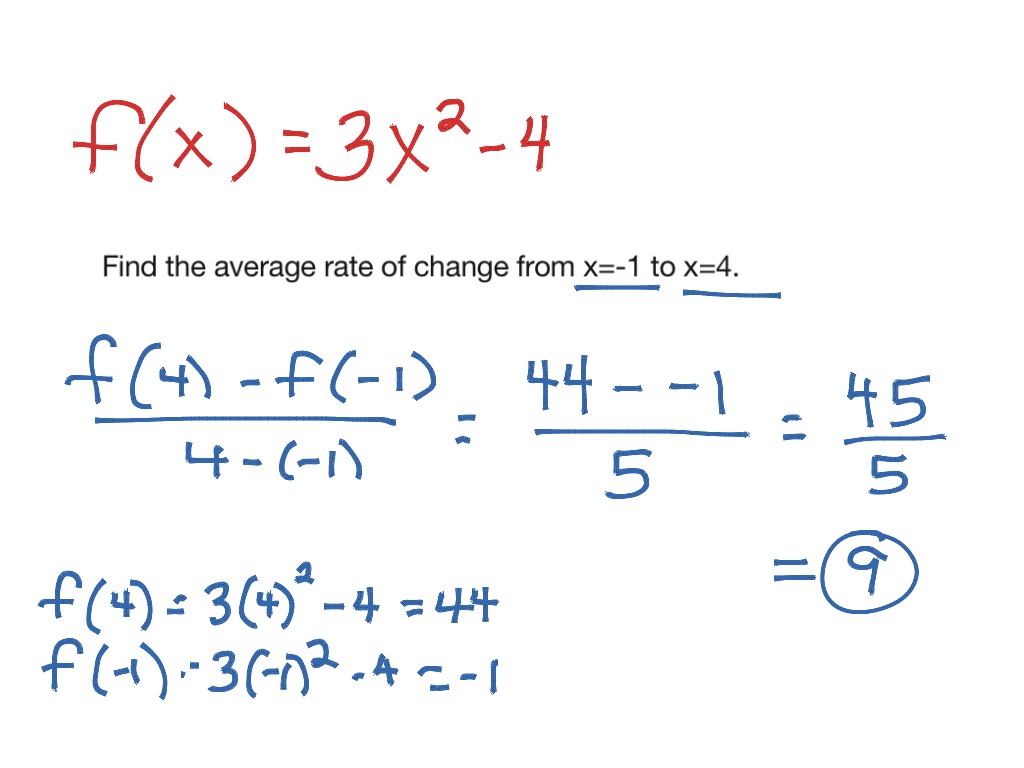
How To Find Average Rate Of Change On An Interval. View the playlists to see the videos grouped into subjects and units. This precalculus video tutorial explains how to calculate the average rate of change of a function over an interval.
ShowMe average rate of change interval quadratic from www.showme.com
From the second point, let b = 4 and g (b) = 2. If you wanted to think about this visually, i could try to sketch this. T3 − 9t2 + 24t + 5, how do you determine the average velocity over the interval (1,2)?
Average Rate Of Change Formula.
And visually, all we are doing is calculating the slope of the secant line passing between two points. And the shorthand for change is this triangle symbol, delta. The average rate of change is 1 over 3, or just 1/3.
If You Wanted To Think About This Visually, I Could Try To Sketch This.
Now for a linear function, the average rate. To find the average rate of change, we divide the change in the output value by the change in the input value. F x x( ) 1 3 over the interval 2,3 2.
The Average Rate Of Change Is:
The average rate of change is zero when the sum of all the positive and the negative slope on the given interval will be zero. How to find the average rate of change between two points using a secant line: From the first point, let a = 1, and g (a) = 1.
F (B) = F (3) = 3 (3 2) + 5 = 32.
From the first point, let a = 1, and g (a) = 1. Instantaneous rate of change vs. Because the slope of this line, the line that connects the endpoints of my interval, that is going to be the average rate of change over this interval.
Use The Coordinates Of The Two Points To Calculate The Slope.
So our change in x is plus five, and so our average rate of change with y with respect to x, or the rate of change of our function with respect to x, over the interval, is going to be equal to three. T3 − 9t2 + 24t + 5, how do you determine the average velocity over the interval (1,2)? F ( 4) = 3 0 f (4)=30 f ( 4) = 3 0.