Identify The Intermolecular Forces Present In Each Of These Substances
Hcl
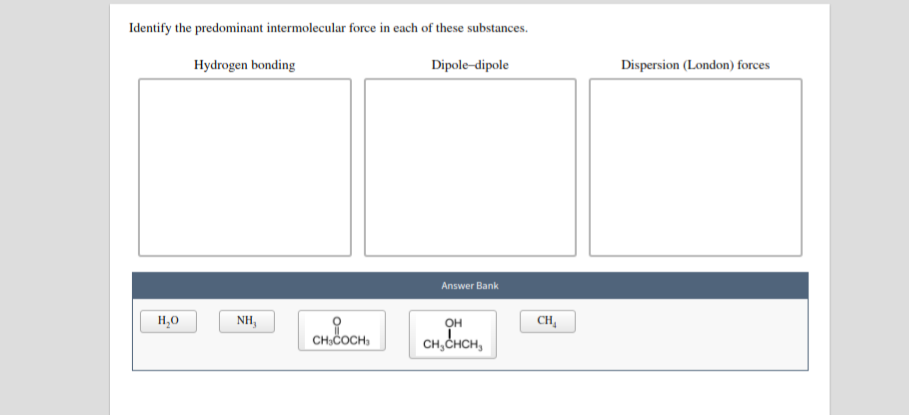
Identify The Intermolecular Forces Present In Each Of These Substances Hcl. Identify the intermolecular forces present in each of these substances. Identify the predominant intermolecular force in each of these substances.
Solved Identify The Predominant Intermolecular Force In E from www.chegg.com
The forces of attraction present in between the molecules or atoms or compounds is termed as intermolecular forces. A substance that simply contains h does not necessarily exhibit hydrogen bonding hydrogen bonding occurs between molecules in which his bonded. Identify the intermolecular forces present in each of these substances.
Our Videos Will Help You Understand Concepts,.
8 which type of intermolecular forces exist among the atoms and hcl molecules? If you are having trouble with chemistry, organic, physics, calculus, or statistics, we got your back! Identify the predominant intermolecular force in each of these substances.
Identify The Intermolecular Forces Present In Each Of These Substances.
7 what is the bond between two hcl molecules? Intermolecular forces present in hcl: There is high difference in electronegativities therefore, it is polar in nature.
(D) Phosgene Cl2Co Or Formaldehyde H2Co.
Identify the intermolecular forces present in each of these substances. Imf includes both attractive as well as repulsive forces. Katyanochek1 [597] 9 months ago.
Expert Solutions For Question Identify The Intermolecular Forces Present In Each Of These Substances.
Identify the intermolecular forces present in each of these substances. Identify the intermolecular forces present in each of these substances. Dipole dipole interaction, hydrogen bonding, and dispersion forces.
The Cl End Of Hcl Has A Permanent Slight Negative.
In the following description, the term particle will be used to refer to an atom, molecule, or ion. Hydrogen bonding occurs in compounds where hydrogen is directly connected to an electronegative element such as n o or f. The electronegativity difference between chlorine and hydrogen is 0.96 showing that the bond is polar covalent in nature.